home
subscribe advance view e-journal new issue authors
» email contents alert
» top accessed articles
» article request
» access registration
» open access articles
» FREE sample issue
» next month's highlights
» list of issues
» 
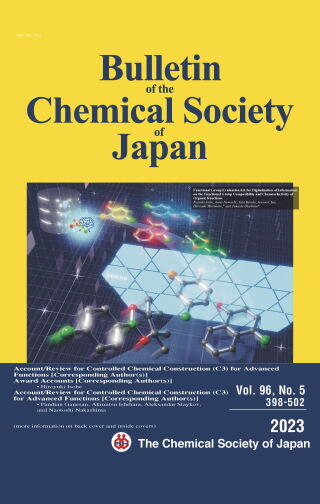
Bulletin of the Chemical Society of Japan

Advance View

Web Release Date: February 2, 2013 (No. 2 issue in press)
   Web Release Date: February 2, 2013
Synthesis of Water-Soluble Cyclophane Pentamers Using Click Chemistry as a Multivalent Host for Daunorubicin and Doxorubicin
 Osamu Hayashida and Yuki Nakamura
[Full Text PDF(J-STAGE)]

Cyclophane pentamer was prepared using click chemistry. Its derivative anionic cyclophane pentamer showed enhanced guest-binding affinity toward anticancer drugs such as daunorubicin hydrochloride, in comparison with those of the monomeric cyclophane.


   Web Release Date: February 2, 2013
One-Pot Synthesis and Evaluation of Properties of Optically Active Poly(imide–urethane)s
 Hojjat Toiserkani and Marziyeh Rafiaee
[Full Text PDF(J-STAGE)]

A series of highly soluble and optically active poly(imide–urethane)s were prepared via one-pot polymerization. The structures, thermal properties, and solubilities of obtained polymers were investigated in detail.

   Web Release Date: February 2, 2013
F–CN Bond Cleavage by Iron Silyl Complex and Electronic Effect of the Group or Atom Attached to Cyano Group: A Theoretical DFT Study
 AbdelRahman A. Dahy and Nobuaki Koga
[Full Text PDF(J-STAGE)]

The mechanism for the cleavage of F–CN bond by [Cp(CO)FeSiMe3] was found to be similar to those of RnE–CN bonds (RnE = H3C, H2N, Me2N, and MeO). The strong Fe–F bond formed, however, affects the energy profile and the reaction mechanism.


   Web Release Date: February 2, 2013
Rapid Removal of o-Phthalaldehyde from Water by Polyallylamine-Conjugated Thermoresponsive Polymer-Mediated Extraction
 Tohru Saitoh, Kotaro Fukushima, and Masataka Hiraide
[Full Text PDF(J-STAGE)]

Thermoresponsive polymer-mediated extraction was useful for rapid removal of a high-level disinfectant, o-phthalaldehyde (OPA), from water. The use of 1 g of polyallylamine-conjugated thermoresponsive polymer allowed nearly complete removal of 130 mg of OPA.


Web Release Date: January 31, 2013 (No. 2 issue in press)
   Web Release Date: January 31, 2013
Cooperation of Hydrogen-Bond and Charge-Transfer Interactions in Molecular Complexes in the Solid State
 Yasushi Morita, Tsuyoshi Murata, and Kazuhiro Nakasuji
[Full Text PDF(J-STAGE)]

Recent developments in our research on hydrogen-bonded charge-transfer complexes and salts are reviewed. The self-assembling ability and electronic modulation effects of hydrogen bonds in the electronic structures of the complexes and salts are summarized.

   Web Release Date: January 31, 2013
Development and Characterization of a Monoclonal Antibody against Triacetone Triperoxide
 Toru Matsumoto, Hiroyasu Yamaguchi, Ken’ichi Kamijo, Miyako Akiyoshi, Takehiro Matsunaga, and Akira Harada
[Full Text PDF(J-STAGE)]

We developed a monoclonal antibody (mAb) specific to triacetone triperoxide. Obtaining the mAb’s hybridoma cell was used by a mouse immunized with a conjugate. The conjugate consists of a spiro-compound with dipropanoic acid and a keyhole limpet hemocyanin.

   Web Release Date: January 31, 2013
Inner-Sphere Structure of Rhodium Complexes with Tin(II) Chloride in Concentrated Hydrochloric Acid Solution
 Hirokazu Narita, Mikiya Tanaka, Hideaki Shiwaku, Yoshihiro Okamoto, Atsushi Ikeda-Ohno, and Tsuyoshi Yaita
[Full Text PDF(J-STAGE)]

The Rh complexes in 3 M HCl solution transform from [RhIIICl5(H2O)]2− to [RhI(SnIICl3)5]4− through the [RhIIICln(H2O)m(SnIICl3)6−n−m]m−3 complex (1 ≤ n ≤ 5, 0 ≤ m ≤ 1) with an increase in the Sn concentration.

Web Release Date: January 10, 2013 (No. 1 issue in press)
   Web Release Date: January 10, 2013
Observation of Dynamic Behavior of Self-Assembled N-Icosyl-Substituted Indigo by STM
 Kazuki Urano, Toshikazu Ohno, Kazuaki Tomono, and Kazuo Miyamura
[Full Text PDF(J-STAGE)]

Surface adsorption structure of indigo substituted by icosyl chain (C20IND) is found to be constituted of mosaic region and homochiral domains. Mosaic region is gradually eaten up by homochiral domains.


   Web Release Date: January 10, 2013
Reassociation of All-trans-3,4-Dihydroanhydrorhodovibrin with LH1 Subunits Isolated from Rhodospirillum rubrum: Selective Binding of All-trans Isomer from Mixture of cis- and trans-Isomers
 Mai Yamamoto, Tomoko Horibe, Yoshiaki Nishisaka, Shuichi Suzuki, Masatoshi Kozaki, Ritsuko Fujii, Matsumi Doe, Mamoru Nango, Keiji Okada, and Hideki Hashimoto
[Full Text PDF(J-STAGE)]

The reassociated complex between all-trans-3,4-dihydroanhydrorhodovibrin (1) and LH1 subunits was prepared. The spectroscopic properties, the singlet energy-transter efficiency within this complex, and the selective formation of the LH1–all-trans-1 complex starting from the cis–trans mixture of 1 were investigated.


   Web Release Date: January 10, 2013
Recyclable Pd-Incorporated Perovskite-Titanate Catalysts Synthesized in Molten Salts for the Liquid-Phase Oxidation of Alcohols with Molecular Oxygen
 Indri Badria Adilina, Takayoshi Hara, Nobuyuki Ichikuni, Nobuhiro Kumada, and Shogo Shimazu
[Full Text PDF(J-STAGE)]

Intercalation of Pd(NO3)2 into layered potassium titanate via cation exchange in molten salts produced a new type of recyclable heterogeneous Pd catalyst for green oxidation of alcohols. The perovskite-type titanate catalyst was highly active and reusable for at least three runs.


   Web Release Date: January 10, 2013
Electronic Properties of Poly[3-(1,1-dimethylpropyl)thiophene] and Poly(3-cyclohexylthiophene)
 Yoshinori Aoyama, Kouji Hatakeyama, Takuma Mukai, and Hitoshi Koizumi
[Full Text PDF(J-STAGE)]

Poly[3-(1,1-dimethylpropyl)thiophene] has too high an oxidation potential to be doped with NOBF4, while poly(3-cycloheyxlthiophene) can be doped with it. However, the doped state decays. The decay process will not be through a deprotonation reaction as poly(3-octylthiophene), but through a reverse process of the doping.

» list of issues
» BCSJ award articles

» submit a manuscript
» submission guidelines
» open access option
» editorial board
» author information

Privacy Policy |  Terms & Conditions |  Site map |  Contact
Copyright 2009 © The Chemical Society of Japan. All rights reserved.