
Immobilization of Enzymes using Water-soluble Metal-organic Polyhedra
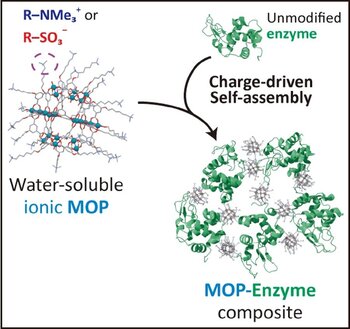
Immobilization can dramatically improve the recyclability and applicability in devices of enzymes. As an alternative to grafting onto surfaces, immobilization as bulk material can be accomplished either by forming cross-linked aggregates, or by encapsulation in porous systems. In our laboratory, we developed a novel strategy, using metal-organic polyhedra(MOPs)as porous spacers to form catalytic heteroaggregates.1)
To avoid the loss of enzyme activity during immobilization, it is necessary to use the mildest possible conditions, and notably perform syntheses in water at neutral pH. To do so, a series of Rh-based MOPs bearing dangling arms functionalized with ionic groups was prepared. In addition to providing good solubility in water, these ionic groups enabled the charge-driven formation of robust MOP-enzyme assemblies. The method was further refined by using a mix-protein approach, with the combination of an active enzyme and an inexpensive network-forming protein.2) This resulted in a simple "mix-and-shake" procedure to obtain MOP-enzyme composites in a systematic and reproducible way, with nearly 100% immobilization efficiency across a wide variety of target enzymes. In addition, the extremely mild conditions of assembly and the intrinsic microporosity of MOPs led to a good retention of enzyme catalytic activity.
1) B. Le Ouay et al., J. Am. Chem. Soc. 2023, 145, 11997.
2) Y. Kanzaki et al., ACS Appl. Mater. Interfaces 2024, 16, 54423.
Benjamin Le Ouay Kyushu University